Showing posts with label recipes. Show all posts

Saturday, January 28, 2023

New Bread Recipe

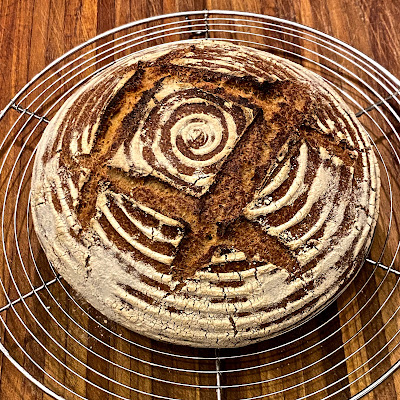
No Knead Cheese & Herb Bread

I have not been baking bread lately because I can get such excellent bread at the General Bakeshop in Brewster and, if I'm in town on a Sunday morning, the She-Wolf Bakery.


However, someone give me a recipe for No Knead Cheese & Herb Bread, which uses the no-knead technique made famous by Jim Lahey in My Bread. This is so much easier than the levain bread technique that I just went and did it.


The bread incorporates 1-1/2 cups of cheddar cheese (I used finely shredded Sargento sharp cheddar from the supermarket), 1 cup (!) of chopped chives and 3 tablespoons of finely chopped thyme. The only thing that takes any time is chopping the herbs. Apart from that it's just waiting for the bread (without the fillings) to rise, folding in the fillings and baking in a preheated dutch oven. 


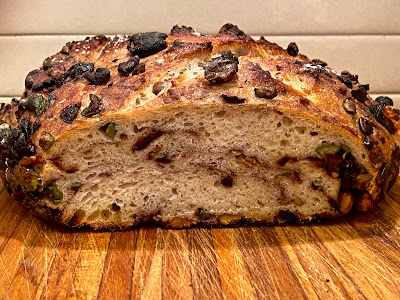
Here you can see the cheese and herbs that infuse this bread.


Cheese & Herb Bread crumb

 A delicious and beautiful loaf!


Bobby Jay


Tuesday, January 3, 2023

Starting 2023 Right -- With a Capon

I have not posted much for the last couple of years, feeling a bit paralyzed by the COVID crisis, although I suffered only a minor case in early 2022. No, it was the first year of forced cooking all the time that kind of knocked a lot of the joy out of food. The second year was much better, with restaurants open and many dinners out with friends.

But this year I hope to do better and am starting early with my capon dinner in Paris the other night.

The French love to eat capons (chapons) for Christmas and New Year's dinners. I tried to make one a few years ago and it was a disaster. I think the problem was my lack of mastery over my oven. This year I decided to try again, and had a great success. Here's how I did it.

I checked Jacques Pépin's Essential Pépin and found a recipe for capon with Armagnac mushroom and cream sauce. Then I ordered a capon from our very good local butcher in Paris. Is this not gorgeous?

Uncooked capon

The butcher told me to simply cook the capon, which weighed 3-1/2 kilos (nearly 8 pounds) for 3 hours at 170 degrees celsius (355 farenheit), starting with the bird in a cold oven. Jacques' instructions were slightly different but I went with the butcher's. My only embellishment was to cook it breast up for the first hour, breast down for the second hour, and finally breast up for the third hour. It came out perfectly, with crispy skin and tender, moist and flavorful meat.

Roasted capon

For sauce I used Jacques' recipe, boiling lots of mushrooms of many varieties in chicken stock and vermouth, then adding cream, Armagnac and a cornstarch slurry at the end, then boiling it briefly. The sauce was delicious, a perfect accompaniment for the capon.

As you can see, I was crowned  LE ROI DU CHAPON by our New Year's guests.

Le Roi du Chapon

Happy New Year!

Bobby Jay

Wednesday, June 1, 2022

Belated Passover Post

As was the case before the pandemic, I made the family seder this year. Pestilence and illness reduced our company to ten, and no one was able to bring matzoh ball soup.

We had lots of hors d'oeuvres. There was Michael Solomonov's fantastic smooth tahini from Zahav,

Michael Solomonov's hummus


my own ricotta, sun-dried tomato and lemon zest spread, gefilte fish bites made from Citarella's excellent fish, with homemade horseradish from America's Test Kitchen's DIY, bar nuts from The Union Square Cookbook and tuna tapenade from Joel Robuchon's The Complete Robuchon.

For matzoh ball soup, I went to Friedman's, a quite good Jewish deli/restaurant with numerous branches around the city. I was thrilled to find a sufficient quantity of soup, but really disappointed when I tasted it.. Weak, salty, with not great matzoh balls. I doctored it as best I could be cooking it with some chopped parsnips, dill and parsley, but to little avail. It was barely adequate.

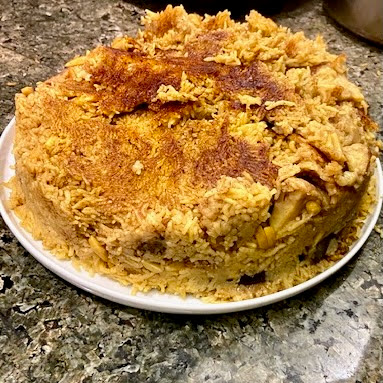
The first main course was Palestinian upside-down chicken  (maqlubeh), in which chicken thighs are cooked with cauliflower florets, eggplant slices, tons of spices and basmati rice and almonds, which are supposed to crisp up like Persian rice. (Recipe courtesy of The Milk Street Cookbook.) It was delicious! Although I didn't get a photo, I have stolen a photo from my dinner of May 31, 2017, which will be covered subsequently.

Palestinian upside-down chicken
The second was a pretty classic seven-hour lleg of amb, with the principal recipe from Bones, by Jennifer McLagan, but with the addition of anchovies, rosemary in garlic in finger-sized holes, as suggested by Simon Hopkinson in his lovely Roast Chicken and Other Stories. Absolutely perfect, without the dryness this dish is prone to.

You can't have a seder without haroset, great on its own but also on matzoh with lots of extreme horseradish: the famous Hillel sandwich. As always, I made two kinds First, figs, date, and apples and walnuts, hazelnuts and almonds, from Judith Nathan's Quiches, Kugels and Couscous: My Search for Jewish Food in France. My second was a Syrian-style dried apricot and pistachio puree that I got from Jennifer Abadi's blog, Too Good to Pass Over. Both incredibly simple and tasty.

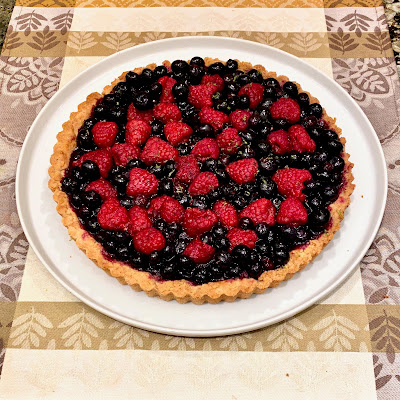
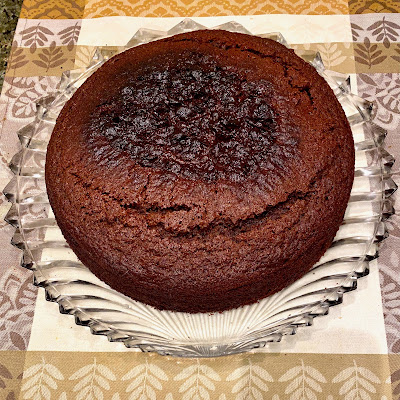
Finally, dessert. Ginger molasses cake from David Lebovitz's Ready for Dessert, in homage to my late mother, who adored this cake and anything else with huge quantities of ginger. And my fresh blueberry tart (to which I add raspberries from Rose Levy Beranbaum, by way of Food52 Genius Recipes, always a hit.

Blueberry and raspberry tart
Ginger molasses cake
For post-dessert, assorted brownies and cookies made by Vicki and homemade chocolate covered matzos from Rebecca.

All in all, it was quite a feast!

Bobby Jay


Sunday, January 16, 2022

Back to bread baking

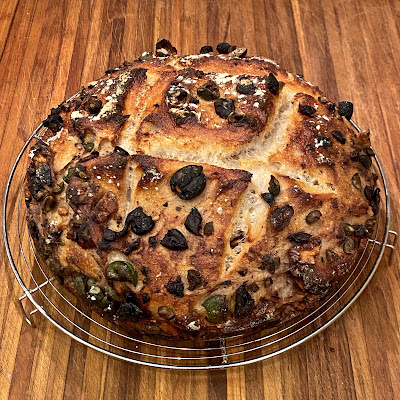
Olive and walnut sourdough bread

I haven’t been making bread for nearly 18 months due to our having to move out of our apartment for four months while renovations were being done, and then our having bought a country home where we spend weekends. I have missed the thrill of home bread-baking so decided to resume, finding a new schedule that avoids weekend preparation.

I bought a lovely new book called Upper Crust: Homemade Bread the French Way, by Marie-Laure Fréchet, and thought this might offer some new opportunities; after all -- France and bread. Maybe it’s me, but my first two tries at a “tourte de meule,” a pretty basic white whole wheat sourdough, were abject failures. Lead weights, useful as a stone for olympic curling , but not fit to eat.

Pretty, but inedible tourte de meule

So I returned to my tried and true sourdough walnut and olive bread for which a use a hybrid of ????‘S levain method, as described in Chad Robertson’s brilliant Tartine Bread, and the sourdough method published by King Arthur Flour Company. Wow, nailed it the first time!

And when I sliced it several hours later, it did not disappoint: salty with a nice texture and an unctuous mouth feel.


I haven't given up on the French method book yet, but I'll try to combine the author's ideas with techniques that I know work for me.

Bobby Jay

Monday, October 12, 2020

Bread Baking in Strange Times (Pain de mic) - Part II

As the pandemic has proceeded, I have continued to bake bread until recently, when Joan and I vacated our apartment to permit some fairly extensive renovations to proceed.

My last post ended with my Tartine/King Arthur Olive bread of June 19. But I have persevered, and present, in excruciating detail probably, my results of the summer.

 On June 25, I made walnut bread, using Tartine's proportions and techniques with King Arthur's sourdough method. A tasty,  beautifully risen loaf.

Tartine/King Arthur walnut loaf

 I repeated this, again to good effect, on July 2.

Tartine/King Arthur walnut loaf

Then I went back to the olive loaf that had been so successful in June. Still delicious.

Tartine/King Arthur olive bread

Next I thought I'd be clever and do a hazelnut bread instead of walnut. It was OK but not a rich or interesting as the walnut, even though I added a tablespoon of hazelnut oil.

Tartine/King Arthur/ Bobby Jay hazelnut bread

Next I discovered the perfect bread: olive walnut bread using Tartine's proportions and technique with King Arthur's easier method. I made this bread twice, on July 27 and August 2. It is salty, olive-y, nutty and rich, all at the same time. As good as any bread I have eaten!


Tartine/King Arthur olive walnut bread July 27, 2020    
Tartine/King Arthur olive walnut bread August 2, 2020

Next, I went back to an old favorite on August 8: sesame bread, again using the Tartine formula and the King Arthur method. A beautiful loaf with lots of sesame taste, almost as good as She-Wolf Bakery's version.

Tartine/King Arthur sesame bread

Then I bought a new book: New World Sourdough, by Bryan Ford. A fun read, with a lot of interesting breads from South America. I decided to make his "toasty seed sour," which contains sesame seeds, flaxseeds, sunflower seeds, pumpkin seeds and rolled oats. I used a hybrid of Ford's method and King Arthur's and got a good, but not great, loaf. I found the many seeds not to product distinctive flavors, just a nice seedy mix.

Bryan Ford "toasty seed sour"

Enough experimentation: I determined to bake bread for our cousins, whom we were going to meet in a park in Connecticut, as well as one for Joan and me, so I used the King Arthur method, but made with 1000 grams of flour rather than 600. I went to my tried and true olive walnut bread, and nailed it again on August 28:

Tartine/King Arthur olive walnut loaves

I returned to sesame on September 3, making my best ever version of this bread, again using a hybrid of Tartine's and King Arthur's methods. Light texture with seriously deep sesame taste.

Tartine/King Arthur sesame bread

For what I expected to be my last bread of the summer, I went to my absolute favorite one last time: olvie walnut bread. It did not disappoint.

Tartine/King Arthur olive walnut bread

 It turned out I was wrong, though, and was able to get in another bread before leaving our apartment. So I went with one of my favorite Tartine breads -- semolina with fennel, sesame and poppy seeds -- and tried using the King Arthur method. Oops! This was not a great success, as I did not make the proper adjustments for the trickier semolina flour. The taste was great, the crust was thick and dark, but the bread was too dense, almost like a dense cake.

Tartine/King Arthur semolina bread with 3 seeds

So that's it for my pandemic bread baking, at least until we get back into our apartment, Christmas at the earliest. In the meantime, I content myself with buying the truly superb breads made by Brooklyn's She-Wolf Bakery, which I find at the Sunday open air market surrounding the Museum of Natural History.

Bobby Jay


Friday, November 29, 2019

Thanksgiving 2019

Time for a breather amid my tales of our trip to Japan . . .

Yesterday was Thanksgiving and, as always, our family met at our apartment. This year we had fourteen, and I decided to repeat my menu of 2018 with few changes. Why argue with success? Here's what I made:

For hors d'oeuvres, I made Michael Romano's great bar nuts from the Union Square Cafe Cookbook, roasted with an inspired combination of rosemary, brown sugar, cayenne pepper, butter and salt,

Union Square Cafe bar nuts
as well as Whipped Feta Dip, from Milk Street, served with fresh pita chips.

Whipped Feta Dip from Milk Street
For some reason, I have been craving tonnato (tuna) sauce lately, the kind used in vitello tonnato. I turned to Marcella Hazan's iconic Essentials of Italian Cooking for her recipe, but altered it greatly to make it into a stand-alone dip, served with little endive leaves for dipping.

Tonnato dip with endive leaves
This was accompanied by Dorie Greenspan's simple but delicious mustard batons and my hors d'oeuve de résistence, Shrimp with Toasted Garlic (Camerones de Ajo) from Tyler Florence.

Tyler Florence's Shrimp with Toasted Garlic (Camerones de Ajo)
This is always a huge hit, especially with my seve year-old great nice and her grandfather (my brother).

For me the actual dinner is less interesting. I made my usual turkey, a version of Julia Childs' deconstructed turkey (which Michael Chiarello's fennel seed rub) cooked over sausage stuffing from The Food Lab (also the source of my gravy recipe),

Deconstructed and carved turkey
accompanied by hashed Brussels sprouts quickly sauteed with lemon and poppy seeds, also from the Union Square Cafe Cookbook (I added toasted pine nuts, which I love, but found they offered little to this dish),

Union Square Cafe's Hashed Brussels Sprouts
and Sweet Potato Gratin from Ottolenghi: The Cookbook,

Ottolenghi's Sweet Potato Gratin
together with my fiery cranberry mostarda, a confit of dried cranberries and cranberry juice, mustard seeds soaked in wine, mustard powder, orange zest, cinnamon and lots of Champagne vinegar, a recipe from Food and Wine.

Cranberry mostarda
For dessert, guests were kind enough to bring a pumpkin pie, a chocolate cake and (yes, it's true) a peppermint cake, but I had to make at least one, in this case Clotile Dusoulier's Flourless Orange and Ginger Cake, a moist masterpiece of a cake suitable for serving friends with celiac disease (my celiac-afflicted friend has become addicted) and for Passover. This is one of my best recipes: it's easy, can be made a day or two in advance and never ceases to please. By the way, I use clementines rather than oranges.

Clotilde Dusoulier's Orange and Ginger Cake
So there it is, a large meal, followed by a good night's sleep and thoughts of what to do next year.

Bobby Jay

Friday, February 1, 2019

What I've Been Cooking - 5

We had two small dinners in January, and I made some old favorites and some new dishes, too. I like to make something I am comfortable with when I have guests but also to experiment a bit; this way at least some will be good.

For Joan's old high school friend and his new wife, I made an eclectic meal. As an hors d'oeuvre, I served my own creation: sun-dried tomato, lemon zest and ricotta crostini on toasted baguette croutons.

Bobby Jay's sun-dried tomato and lemon zest spread
Although I rarely start with a salad, that night I served an appetizer salad inspired by one we had at Grüner, in Portland, Oregon. It consisted of thinly slice mushrooms, even more thinly sliced radishes, radish sprouts, arugula, lots of chopped dill and chives, parmesan slices, toasted pumpkin seeds and a pumpkin seed oil vinaigrette. Sounds like a lot is going on, but somehow it works.
-->
Next up was Marcella Hazan's lamb stew with artichokes, a classic that I hadn't made in about ten years. Still excellent, with the subtle earthiness of the artichokes complementing the lamb perfectly. I served it over simple slow-cooked polenta, with roasted asparagus with almonds, capers and dill as a side.

Lamb stew with artichokes, polenta
For dessert, I tried apple tart Normande, based on a recipe from David Lebovitz' blog. It came out beautifully and tasted great, although it is a rather rich tart due to the addition of a fair amount of cream (hence "Normande").

Apple tart Normande
Later in the month, we had the assistant director of a major museum, who goes by the name Kintaro, for dinner. We had simple but elegant cauliflower soup from Food52 Genius Recipes, garnished with chopped pumpkin seeds and pistachio oil,

Cauliflower soup
followed by roast halibut with tahini-herb sauce (see post of January 30), accompanied by green beans sautéed with almonds and herbes de Provence.

After a simple salad with a hearty Caesar-like vinaigrette, I served a blackberry and raspberry batter cobbler, based on a recipe from Food52 Genius Desserts, which came out exactly as pictured in the book.

Blackberry and raspberry cobbler
Almost forgot that I made chocolate and coconut filled macarons mutines, slavishly following a recipe from Pierre Hermé, the king of macarons, for Joan to give to her clients and colleagues at The Winter Show, New York's premier art and antiques show, where she is an exhibitor.

Macarons mutines
These are really great! Making them is a great way to become popular, definitely worth the considerable effort they take.

Bobby Jay

Wednesday, January 30, 2019

What I've Been Cooking - 3

I've been interested in Middle Eastern cooking for a number of years, and was psyched to read Naz Deravian's Bottom of the Pot, named for the tahdig crust formed on the bottom of a pot of Persian rice (before being inverted to make a gorgeous top), one of my top ten foods in the world.

Joan was away so I decided to make just one dish to get acquainted with this book, which I had read in full: kashki bademjan, an eggplant dish made with kashk (a pungent cheesy distillation of cooked down and concentrated yogurt) and a topping of fried onions, garlic and mint.

The dish was tasty if not pretty, with an interesting interplay among the earthy eggplant taste (accentuated by turmeric), the funkiness of the kashk and the kick of the onion-garlic-mint mixture:

Eggplant dip with kashk
I accompanied the dish with Persian rice, not one of the ones in Bottom of the Pot, which entail quite a bit of work, but rather the recipe in Melissa Clark's Dinner in an Instant, which I have made numerous times (indeed, this picture is from an earlier meal). I added tons of dill and, with the eggplant dish, had a lovely and healthful meal.

Persian rice
Joan returned from Japan the next day, and she enjoyed reheated versions of both dishes, the eggplant dish having been given a shot of brightness by adding pomegranate seeds, an innovation I will use again next time.

Bobby Jay

What I've Been Cooking - 2

While Joan was still in Japan, I received a package of persimmons from a great friend, who had gotten them from her friend in California, who has a wonderful tree. But they came with a stipulation: I was required to make a dish incorporating persimmons to be photographed and sent to the person with the tree for her judgment. Two others were included in the competition, both far more experienced than I; indeed, one has a well-known pastry shop in New York.

I thought about this for a couple of days and decided to make a tarte tatin using persimmons instead of apples. I used the basic techniique from the Confrérie des Lichonneux de la Tarte Tartin (Brotherhood of Tarte Tatin Lovers), with some brilliant additions from Paula Wolfert's The Food of Morocco, namely the addition of dried currants (Wolfert uses raisins but I wanted something less sweet) and orange flower water.

Here's my tarte tatin aux kakis Yamazaki. Quite a beautiful tart, I think,

Persimmon tarte tatin
but the persimmons were a bit mild-tasting for this dessert, being a bit overwhelmed by the bitterrness of the caramelized sugar and the heavily scented orange flower water. If I make it again . . .

When Joan's away I like to bake bread, so I made some levain country rye loaves from Chad Robertson's iconic Tartine Bread.

Levain country rye bread
It is so satisfying to get loaves that look like this, and have that sour taste that can only be found in a genuine levain bread. A serious scheduling problem, since the process takes about 24 hours and has a number of steps, but worth it when it comes out.

Bobby Jay


What I've Been Cooking - 1

People I meet, when they learn of my passion for cooking, invariably ask what kind of food I like to cook. And the answer is "everything" because I love learning new techniques and flavors. That being said, I return again and again to certain favorites, generally Italian, French or American. Looking at some of the main things I've cooked over the past couple of months gives a flavor for how I approach selection of dishes to try and how I like to plan menus.

For the first major meal after Thanksgiving, I made roast halibut with tahini herb butter, a brilliant recipe (intended for cod, which Joan doesn't like) from Christopher Kimball's new book, Milk Street Tuesday Nights (more on this book and the others mentioned herein in a later post). To counterbalance the very interesting flavors of the fish I served Peruvian fingerling potatoes from the great potato grower at the Upper West Side greenmarket sautéed with rosemary,

Roast halibut with tahini-herb sauce and Peruvian fingerlings
sautéed leeks with a little crème fraîche and a simple green salad. Dessert was a baked Winesap apple (courtesy of my idol Jacques Pépin's Essential Pépin) stuffed with wonderful griotte cherry preserves that I buy in Paris.

Continuing with Milk Street Tuesday Nights recipes, I  made Singapore Shrimp the next day, a dish imbued with Southeast Asian flavors, such as ginger, lemon grass, fish sauce, rice vinegar, etc. Easy and very flavorful, if probably not authentic. I served this with Jasmine rice and green beans sautéed with a little soy sauce and Japanese furukake, a blended spice mixture. The starter was artichoke steamed in the Instant Pot. As you can see, I am not married to any culture, even for one meal, but like to mix and match.

Continuing in the same vein, the next day I made (for myself since Joan was in Japan) Moroccan chicken skewers, also from Milk Street Tuesday Nights, incorporating a North African profile to elevate pretty simple skewers of boneless skinless chicken thighs. The following day I continued with Vietnamese meatball lettuce wraps from the same cookbook. Both dishes were successful, particularly the chicken skewers.

Now a new cookbook arrived: Simple, from Yotam Ottolenghi, one of my favorite cookbook authors. I was still alone and took advantage of Joan's absence to have a steak, which she does not eat. In this case it was Ottolenghi's harissa steak, made with skirt steak and a strong harissa sauce. Although it was fine, I found that the harissa marinade dissipated in the grilling of the meat, requiring me to heap raw harissa over the final product.

A couple of days later, it was back to Milk Street Tuesday Nights for jerk-roasted chicken wings (the recipe is for chicken parts, but a lonely bachelor needs his wings): simple and very well spiced, it was worth using the recipe's homemade jerk sauce rather than using store-bought.

Jerk-roasted chicken wings
Next I took a baking interval, as described in the next post.

Bobby Jay